Why Eritrea's Red Sea coastline is drawing new attention
Deutsche Welle reports that Eritrea's Red Sea ports and its position near the Bab al-Mandab Strait are making Asmara an increasingly important regional player — while analysts warn that a state built around one man is also fragile.
By Eyob Hadgu · 24 August 2026 · Updated 23 September 2026
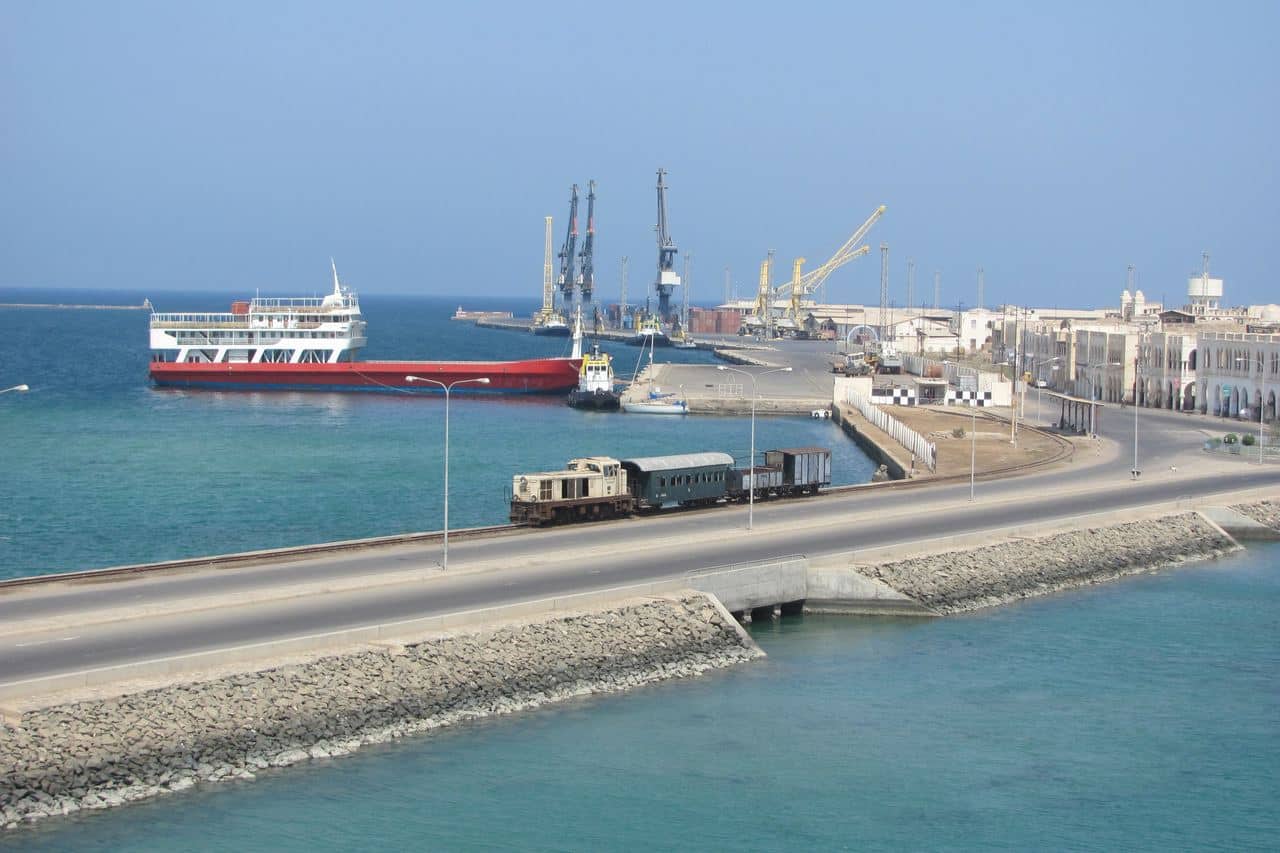
The port of Massawa, on Eritrea's Red Sea coast. Photo: Reinhard Dietrich / Wikimedia Commons, CC0 1.0 (public domain)
Eritrea's Red Sea coastline is drawing renewed attention as tensions rise across the Horn of Africa, according to a report by Martina Schwikowski for Deutsche Welle (DW). The report describes Eritrea, run by long-standing ruler Isaias Afewerki, as an emerging key player in the region, pointing to its control of strategically important coastal points — especially the ports of Assab and Massawa.
The country's coastline near the Bab al-Mandab Strait stretches for more than 1,000 kilometres, bordering Sudan to the northwest and Djibouti to the southeast. The strait connects the Red Sea to the Gulf of Aden.
Why the location matters
"Yemen lies on the other side of the Red Sea, which makes Eritrea's location particularly interesting, as Yemen is in a state of crisis and maritime security in the region is at risk," Abdurahman Sayed, director of the Horn of Africa Centre for Regional Integration (CRI) in London, told DW.
"For this reason, all countries — including regional powers such as Saudi Arabia and Egypt, which controls the Suez Canal — want to maintain stable relations with Eritrea," Sayed said.
"For this reason, Eritrea today is of great strategic importance. This has been the case for centuries and will continue to be the case." — Abdurahman Sayed, Horn of Africa Centre for Regional Integration
DW reports that in July, a series of diplomatic consultations in Cairo involving Egypt, Somalia, Eritrea and a high-ranking US envoy highlighted Eritrea's growing role in helping to coordinate approaches to security challenges in the Horn of Africa and the Red Sea, and to facilitate trade.
Rivalry with Ethiopia
"The key context for Eritrea's recent strategic maneuvers in the Horn of Africa and the Red Sea is the escalating tensions with Ethiopia," Michael Woldemariam, a researcher at the University of Maryland's School of Public Policy and the Atlantic Council, told DW.
For decades, DW notes, Djibouti has dominated regional trade logistics as Ethiopia's most important seaport partner, while Eritrea has been sidelined economically. Asmara Post has previously reported on how the dispute over Red Sea access is straining the Tigray peace deal.
A fragile strength
Sayed cautioned that the concentration of power behind Eritrea's predictability is also a weakness. "The country is ruled by a single man, and there are no constitutional institutions. That makes the state very vulnerable should this strongman be removed from power," he said.
The report also points to the human cost. At least 700,000 people have left Eritrea since its founding, DW reports — about a fifth of its total population. Magnus Treiber, a migration researcher specialising in the Horn of Africa at the University of Munich's Institute of Ethnology, told DW that since 2001 people have again been leaving in large numbers "from human rights violations, military service, war, and a lack of prospects."
This report draws on reporting by Deutsche Welle (DW), republished by Martin Plaut.
Get Asmara Post in your inbox every Thursday.
One weekly email. No spam, unsubscribe anytime.