UN chief "gravely concerned" by fighting in northern Ethiopia and by reports of Eritrean forces in the country
António Guterres has called for an immediate end to hostilities and a return to talks under the 2022 Pretoria Agreement. The UN says people are being displaced across Tigray and that it has no verified figures.
By Eyob Hadgu · 10 October 2026
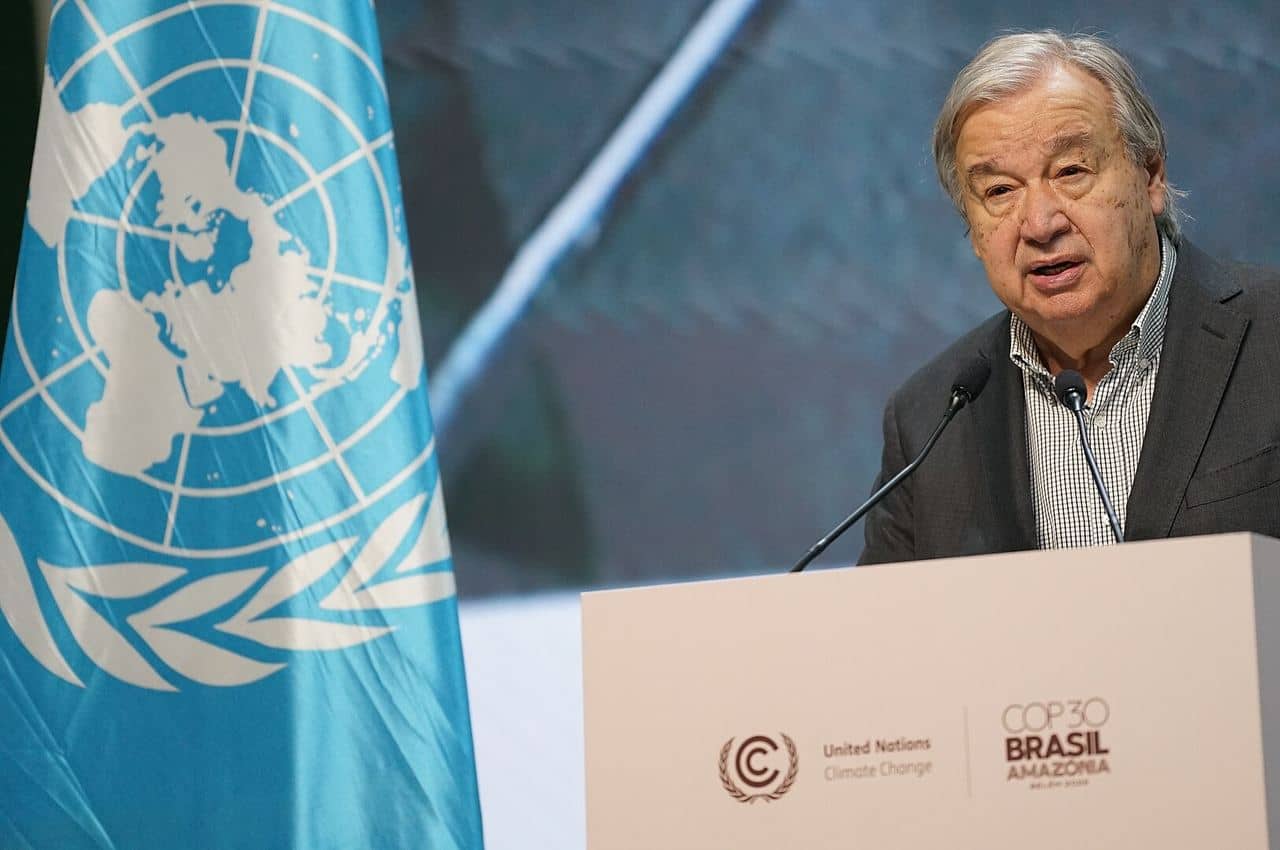
UN Secretary-General António Guterres, pictured at the COP30 climate conference in Belém, Brazil, in November 2025. Photo: Xuthoria / Wikimedia Commons, CC BY-SA 4.0
UN Secretary-General António Guterres has called for an immediate end to the renewed fighting in northern Ethiopia and said he is deeply worried by reports that Eritrean forces are present in the country, UN News reported on 10 October.
In a statement issued through his spokesperson, Stéphane Dujarric, Guterres said he was gravely concerned. He urged all parties to cease hostilities and called on the signatories of the 2022 Pretoria Agreement, which ended the last war in Tigray, to return to dialogue.
A warning to the region
Guterres said the fighting in the Tigray, Afar and Amhara regions risks escalating in ways that would further destabilise the wider region, according to UN News.
He reminded states of their obligation to "refrain from the threat or use of force against the territorial integrity or political independence of any State." The UN also appealed to countries in the region with influence over the parties to support de-escalation.
The statement did not take a position on the competing accounts from Addis Ababa and Asmara. UN News noted that Ethiopia has accused Eritrea of an "all-out invasion" of Tigray, with its foreign minister saying Eritrean troops had advanced up to 60 kilometres into the region. Eritrea has rejected the claim. Its information minister said his country faces an "unprovoked war of aggression," and Eritrea denies backing the Tigray People's Liberation Front (TPLF).
UN News also reported that Ethiopian drone strikes are said to have hit Eritrean forces in the Tigrayan town of Adigrat, and that the TPLF withdrew last week from the regional capital, Mekelle, which is now under army control.
Aid access and displacement
The UN's humanitarian affairs chief, Tom Fletcher, called earlier this week for all parties to give aid workers safe and rapid access to people in need.
UN teams are still working to get food, healthcare and other life-saving assistance through, UN News reported, but continued hostilities are displacing people across central, north-western and eastern Tigray. The UN said verified figures are not available. In the Amhara region, a government-assisted effort to return displaced people from the town of Kobo was suspended because security had deteriorated.
Why it matters for Eritreans
Fighting between the federal government and the TPLF resumed about two weeks ago. When Asmara Post reported on the war on 30 September, Guterres had expressed concern over the renewed fighting and harm to civilians. His latest statement goes on to name the reported presence of Eritrean forces as a specific worry.
The reminder about territorial integrity comes as each government accuses the other of aggression.
Eritreans are also among those exposed to the fighting. As Asmara Post reported on 30 September, about 60,000 Eritrean refugees live in camps in Ethiopia's Afar region, according to UNHCR figures cited by the Mixed Migration Centre, and at least 150,000 people had been displaced in Afar by late September, according to AFP.
The African Union has also called for restraint and a return to talks under the Pretoria Agreement.
This report draws on reporting from UN News (also carried by AllAfrica), and on earlier Asmara Post coverage based on AFP, UNHCR and the Mixed Migration Centre.
Get Asmara Post in your inbox every Thursday.
One weekly email. No spam, unsubscribe anytime.