At least 150,000 displaced in Afar as Ethiopia's new northern war enters its second week
Tigrayan forces have pushed east towards the corridor that carries almost all of Ethiopia's trade, a drone strike took Tigrai TV off air, and a conflict monitor says the rebel alliance is more divided than it looks.
By Eyob Hadgu · 30 September 2026
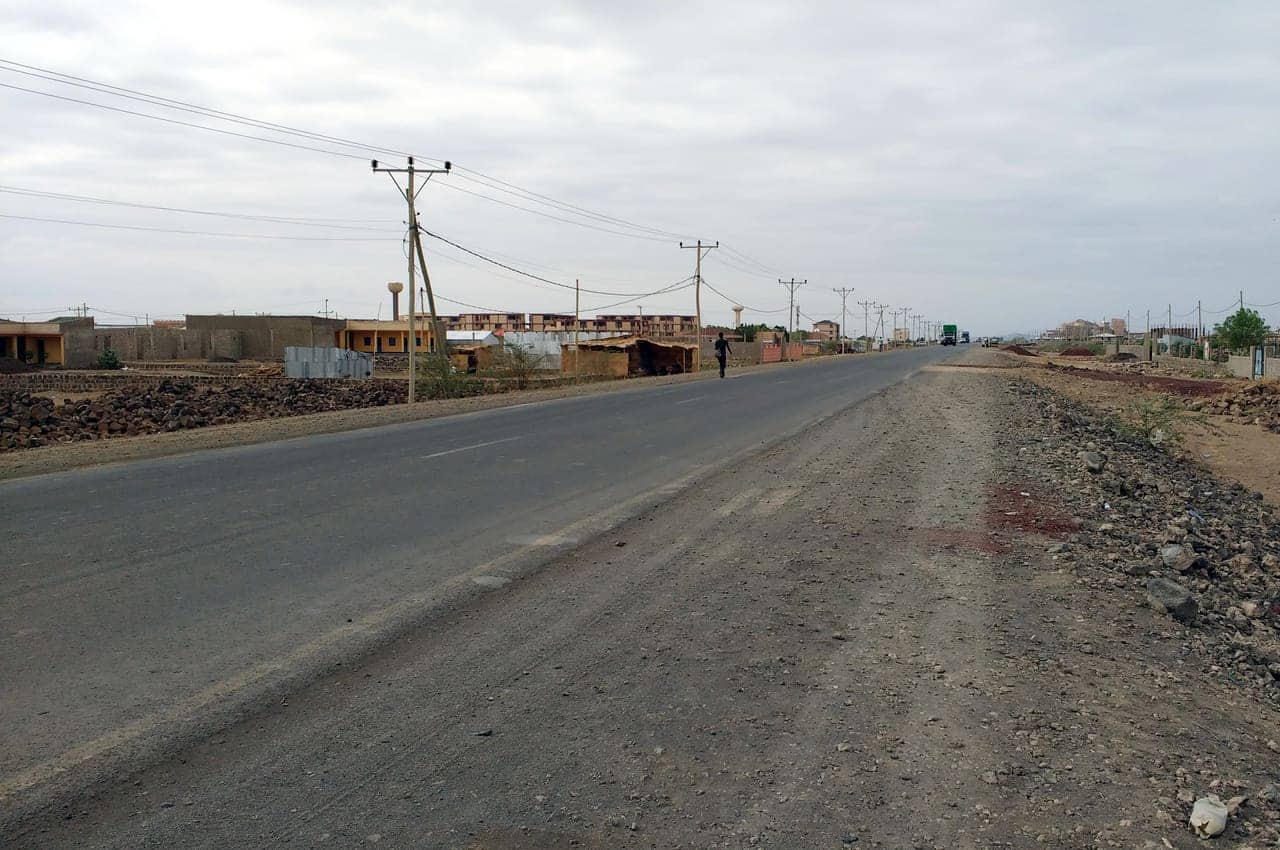
The Djibouti road through Semera, capital of Ethiopia's Afar region, part of the trade corridor between Addis Ababa and Djibouti. Photo taken in 2015. Photo: Albert Backer / Wikimedia Commons, CC BY-SA 4.0
At least 150,000 people have been displaced in Ethiopia's Afar region as fighting between Tigrayan forces and federal troops spreads beyond Tigray, a humanitarian source told AFP. The source cautioned that precise figures were not available. The Associated Press attributed the same estimate to the Afar Pastoralist Development Association.
The town of Erebti, near the Tigray border, fell to Tigrayan forces on Sunday, 27 September, after heavy artillery fire, according to AFP reporting carried by Addis Standard and Euronews. The fighters were advancing towards Afdeera, about 100 kilometres farther east.
Why Afar matters
Euronews reported that the push into Afar targets the Djibouti corridor, which carries nearly all of Ethiopia's international trade, including fuel. Control of that route would give the rebels significant leverage over the federal government, although it would risk antagonising Djibouti.
Dr Jalale Getachew Birru, East Africa senior analyst at the conflict monitor ACLED, told Euronews that the federal government still regarded the fighting as "a manageable challenge," pointing to the open trade route through Djibouti and government gains in the Wag Hamera and Southern Tigray zones. Tigrayan control of the Semera-Djibouti route could change that calculation, he said.
In the south of Tigray, government forces and the Tigray Peace Force said they had captured Alamata, a supply hub about 120 kilometres south of Mekelle, Al Jazeera reported. Reuters verified video showing soldiers carrying Ethiopian flags in the town.
Civilians and the media
A drone struck the Mekelle headquarters of Tigrai TV on Sunday, forcing staff to evacuate and taking the station off air, Addis Standard reported. The federal government had already suspended the broadcaster indefinitely on 21 September. Internet disruptions in Mekelle and blocked roads in Afar are making humanitarian access and independent reporting harder.
Doctors Without Borders (MSF) reported that the number of wounded patients at hospitals in Korem and Alamata rose from about 180 to more than 420 in 48 hours, according to Al Jazeera and AP. ACLED said MSF recorded more than 700 war-wounded patients across the Southern and North-Western zones of Tigray between 22 and 25 September.
The UN High Commissioner for Human Rights, Volker Türk, said he was "deeply alarmed by the recent escalation in hostilities." He cited airstrikes that hit five schools on 22 September and alleged forced recruitment campaigns by the TPLF. Euronews reported that many residents fear a repeat of the blockade imposed during the last war, when electricity, banking and aid were cut off.
A fragmented alliance
Media reports describe a seven-group "Alliance for Survival" ranged against the government. ACLED said on 29 September that its monitoring shows a more fragmented picture, with only three groups currently fighting in the north. On 26 and 27 September, it said, Fano units loyal to the leader of the Amhara Fano National Movement clashed with the Belay Zeleke Command in South Gonder zone over whether to cooperate with the TPLF.
"The emerging picture is therefore not simply one of a strengthening alliance, but of escalating violence alongside a fragmented and potentially unstable coalition of armed groups," Dr Jalale said.
An analysis by an unnamed Ethiopian analyst, published on Martin Plaut's blog, described the war as heading towards a "dynamic stalemate." It said the federal army has reportedly deployed around 400,000 troops and about 80 percent of its heavy artillery. It also said Eritrean forces have not openly engaged but could become significant through intelligence and artillery support, particularly if Mekelle were threatened with capture.
The African Union has called for "utmost restraint" and urged a return to talks under the 2022 Pretoria Agreement, which ended the last war.
This report draws on reporting from AFP (via Addis Standard and Euronews), the Associated Press, Al Jazeera, Reuters and ACLED, and on analysis published by Martin Plaut.
Get Asmara Post in your inbox every Thursday.
One weekly email. No spam, unsubscribe anytime.