Ethiopia's army chief accuses Eritrea of linking Sudan and Egypt to the Tigray offensive; Asmara, Khartoum and Cairo reject the claim
Field Marshal Birhanu Jula said Eritrea acts as a go-between for foreign powers backing the armed groups fighting federal forces, but presented no public evidence. All three governments have denied it.
By Eyob Hadgu · 30 September 2026
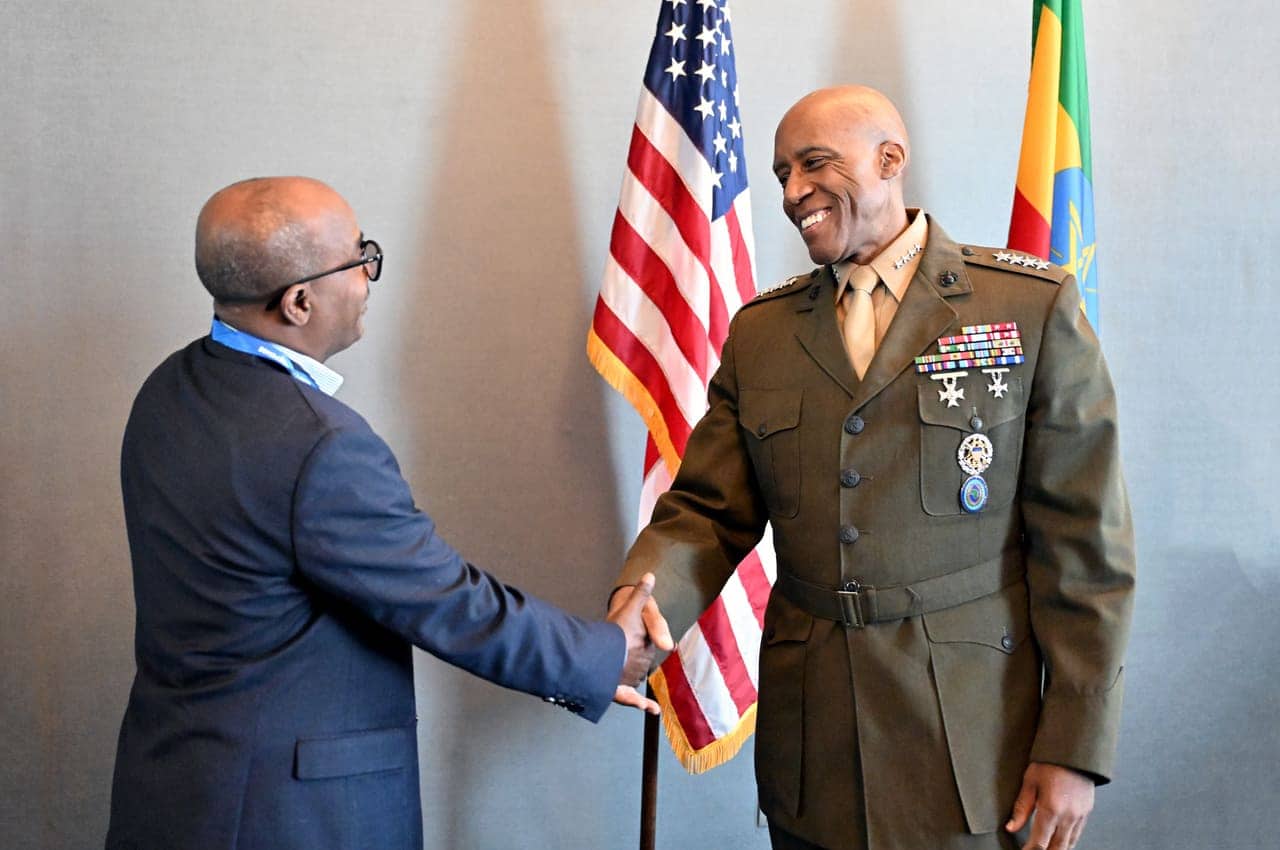
Field Marshal Birhanu Jula, left, chief of Ethiopia's armed forces, meets US Africa Command's General Michael E. Langley at the African Chiefs of Defense Conference in Nairobi in May 2025. Photo: Jason Johnston / U.S. Africa Command via Wikimedia Commons, public domain
Ethiopia's army chief has accused Eritrea, Sudan and Egypt of backing the armed groups fighting federal troops in the north of the country, as the war that resumed on 23 September spread from Tigray into the Afar and Amhara regions.
Field Marshal Birhanu Jula, chief of the general staff of the Ethiopian National Defense Force, accused Eritrea of mobilising financial support for the Tigray People's Liberation Front (TPLF), the Associated Press reported. Al Jazeera reported that he described Eritrea as the "go-between" linking external powers, including Sudan and Egypt, with armed groups inside Ethiopia, and blamed the unrest on Ethiopia's "historical and contemporary adversaries."
"We are fighting forces that are organised and allied to serve the interests of external forces," Birhanu said, according to AFP reporting carried by France 24. "Neither Shaebia (Eritrea) nor the TPLF can achieve anything alone, even if they are allied, unless they are backed, supported and supplied by Sudan, Egypt and other external powers."
RFI and Al Jazeera both noted that he presented no public evidence for the claims.
Three denials
Eritrea's Information Minister, Yemane Gebremeskel, rejected the accusation. Writing on X, he said Ethiopia's pursuit of access to the sea had rattled Eritrea and Somalia, and that its move to host militia training in support of Sudan's paramilitaries had put Ethiopia at odds with its neighbours, AP reported.
Sudan's armed forces called the accusations "baseless." Sudan in turn accuses Ethiopia of helping the paramilitary Rapid Support Forces (RSF), which has been fighting the Sudanese army since April 2023. Ethiopia denies this. Each government denies involvement in the other's war, RFI reported.
Egypt's Foreign Ministry spokesperson, Nader Zaki, said "Egypt is fully committed to the rules of international law" and rejects practices that undermine regional stability, Al Jazeera reported. Major-General Samir Farag added that such interference "has not been Egypt's policy."
Why Eritrea is at the centre
For Eritreans, the accusation reverses the alliance of the last war. Al Jazeera noted that Eritrea fought alongside Ethiopia against Tigrayan forces in the 2020-2022 war but has since grown concerned about Ethiopia's ambitions on the Red Sea. France 24 reported that Eritrea could be drawn into the conflict on the rebels' side because it fears landlocked Ethiopia has been planning to invade and seize direct access to the Red Sea.
The charge is not new. AP reported that both the army and Prime Minister Abiy Ahmed have previously accused Eritrea of supporting domestic insurgencies, which Eritrea has denied. As Asmara Post reported on 23 September, a spokesperson for Abiy told Reuters that members of the new anti-government alliance "had been collaborating for a while with Eritrea's financial backing."
Egypt and Ethiopia have also been at odds since 2011 over the Grand Ethiopian Renaissance Dam on the Nile, Al Jazeera noted.
A regional war?
Some analysts quoted by Al Jazeera read the accusations as a response to pressure at home. Amani al-Tawil called them "an understandable attempt to escape from internal crises." The writer Ammar Arki warned that a prolonged focus on an "external conspiracy" risks turning Ethiopia's internal conflict into a regional war.
On the ground, Tigrayan forces took the Afar town of Erebti after heavy artillery fire and were advancing towards Afdeera, about 100 kilometres farther east, RFI reported. At least 150,000 people have been displaced in Afar. UN Secretary-General Antonio Guterres expressed concern over the renewed fighting and harm to civilians. The 2020-2022 war killed an estimated 600,000 people, according to African Union estimates.
This report draws on reporting from the Associated Press, Al Jazeera, France 24 (AFP) and RFI, and on earlier Reuters reporting.
Get Asmara Post in your inbox every Thursday.
One weekly email. No spam, unsubscribe anytime.