Eritrean rights groups press UN council to pick a Special Rapporteur who knows Eritrea
Three diaspora organisations have written to Human Rights Council member states ahead of the September session, arguing the next mandate holder must have substantive expertise on Eritrea rather than general human rights experience.
By Eyob Hadgu · 5 September 2026
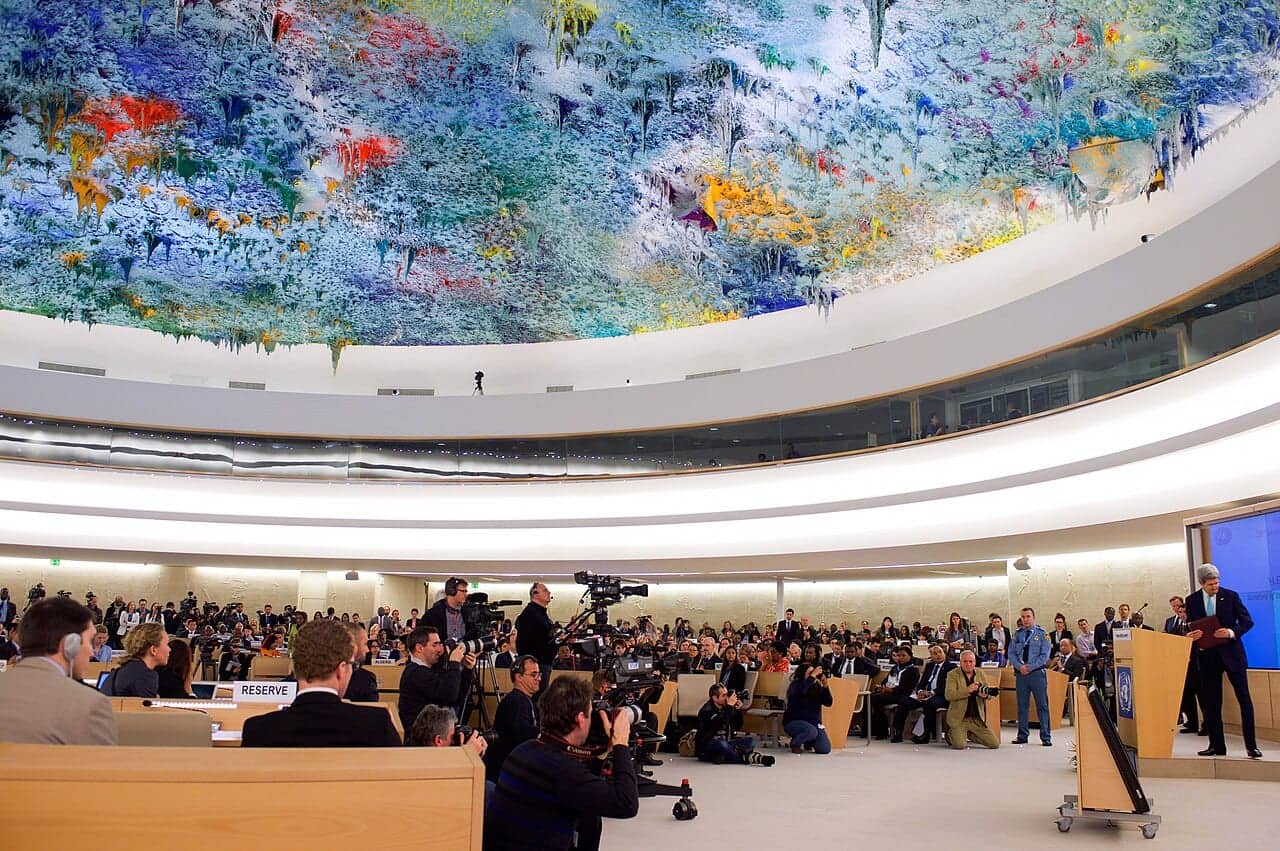
The Human Rights Council chamber at the Palais des Nations in Geneva, where the Council's 63rd session opens on 7 September. Photo: U.S. Department of State / Wikimedia Commons, public domain
Three Eritrean diaspora organisations have written to the member states of the UN Human Rights Council urging them to appoint a Special Rapporteur on human rights in Eritrea who has specific expertise on the country, rather than a candidate with only general human rights credentials.
The letter, dated 4 September 2026 and published by the Eritrea-focused site Martin Plaut, was signed by the Daerona Community Eritrean Global Network, Eritrean Human Rights Defenders in the Netherlands, and Eritrean Human Rights Defenders in Switzerland.
What the letter asks for
The signatories ask member states to elect a mandate holder with "specific expertise on Eritrea, including a strong understanding of its political, legal, and human rights context; experience in independent monitoring and investigation; and knowledge of the experiences of Eritrean victims and affected communities."
The letter asks the Council to weigh country-specific knowledge, not just general human rights credentials, when it picks the next mandate holder.
The timing matters. On 6 July 2026 the Council decided to extend the Special Rapporteur mandate on Eritrea for a further year. The election of the person who will hold that mandate is due during the Council's 63rd session, which runs from 7 September to 7 October 2026.
The case the organisations make
The letter argues the appointment matters because of the conditions it says the mandate has to document. It describes Eritrea as an authoritarian state without effective constitutional safeguards, judicial independence, or the rule of law, and cites arbitrary detention, enforced disappearance, restrictions on basic freedoms, and indefinite national service.
The organisations also raise transnational repression — pressure they say reaches Eritreans living outside the country, including diaspora communities and refugees. That framing puts the appointment directly in front of the readers of a diaspora outlet: the signatories are arguing that what the Council decides in Geneva this month affects Eritreans in Europe and North America, not only those inside the country.
The Special Rapporteur post is one of the few standing international mechanisms that reports publicly on Eritrea's human rights record. The Eritrean government has consistently rejected the mandate's legitimacy and has not granted its holders access to the country.
This report draws on the letter as published by Martin Plaut.
Get Asmara Post in your inbox every Thursday.
One weekly email. No spam, unsubscribe anytime.